EQ: How can a paleontologist best reconstruct the life of a prehistoric creature?
Friday, February 5, 2016
Findings from Gem-O-Rama and Great Trona Pinnacle Scenery
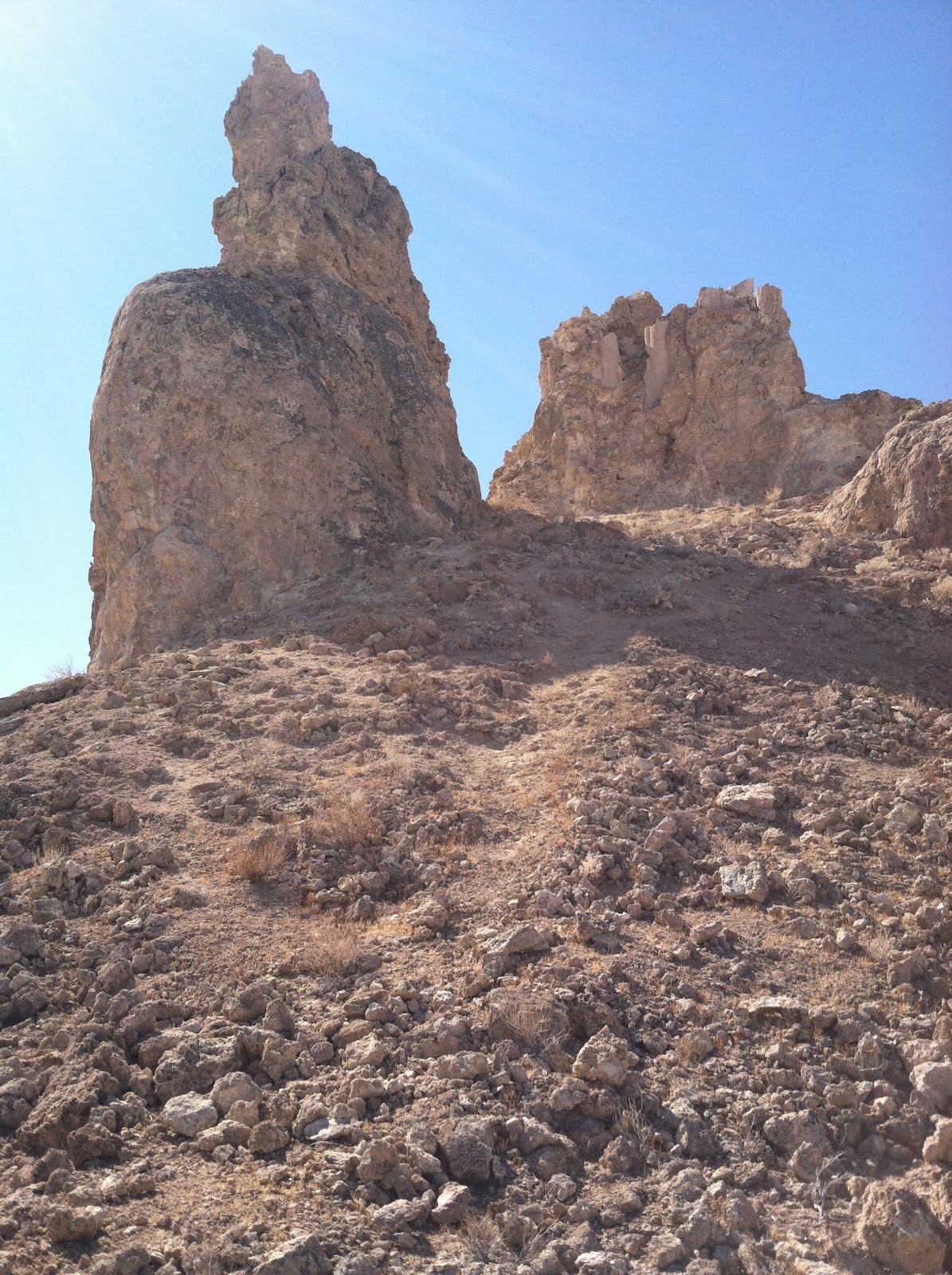
Here are a few of the crystals I found during my trip to Trona and some of the pictures I took from my perspective while hiking through the Trona Pinnacles.


Independent Component 1
Literal
a. I, Santiago Hernandez, affirm that I completed my independent component which represents 30 hours of work.
b. "The Trona Pinnacles." Ridgecrest Field Office. US Department of the Interior: Bureau of Land Management, 8 Oct. 2014. Web. 4 Feb. 2016.
State of California Department of Conservation. Jennings, Charles W., John L. Burnett, Bennie W. Troxel. Geologic Atlas of California - Trona Sheet. Map. 1:250,000. 1962. Web. 4 Feb. 2016.
Trona Pinnacles. Trona: Searles Lake Gem & Mineral Society, 2015. Print.
d. I participated in the "Mud trip" and "Pink Halite" trips made available in Trona, California where I collected crystals and prospected for fossils and hiked in the Trona Pinnacles. I later cleaned the Hanksite crystals that I collected from the Mud trip at home and then wrote an essay detailing the probability of their being fossils at the Trona Pinnacles and detailing the context of such fossils.
Interpretive
| Normally when a Paleontologist prospects for fossils they have to use a tool like a pickaxe to extract the fossils from the surrounding matter. |
| Like a paleontologist, I had to keep a sharp eye out to discern a crystal from a worthless hunk of mud and rock. The picture above shows me holding the largest Hanksite cluster that I found. |
| Underneath the crystals I have on display is the ledge of salt where the Pink Halite crystals were more abundant. Sometimes paleontologists just find areas that are rich in fossils. |
| During the hike, I found this tiny fragment of a bone, but according to my mentor it was just "last weeks dinner" and not a fossil. This shows how observant I had to be to even find anything like this among the rocks. |
| Here I am clearing the mud off my Hanksite crystals just as a paleontologist would clean a fossil that is inside a chunk of rock. |
| After cleaning it in brine, the Hanksite crystals look really nice. This specific specimen has a tinier conjoined twin on its side. |
After my trip to Trona, I needed to clean my Hanksite crystals and so this relates to paleontology because paleontologists don't always find fossil fragments, sometimes they have to extract it within a chunk of earth and have to take it to a lab to thoroughly remove all the matrix. The Hanksite crystals simulated this because I pretty much had to take them home with some of the mud that I found them in.
The essay I wrote relates to how probable it would be to find fossils at the Trona Pinnacles and the context they. This essay serves to simulate how paleontologists publish papers on any number of topics related to paleontology that add to scientific knowledge. My essay does this by analyzing the sedimentological makeup of the area around the Trona Pinnacles and their formation to reach an understanding of how viable that environment might have been to fossilize a creature.
Applied
Paleontologists largely rely on fossils as pieces of evidence to explain a world long gone. In the case of my independent component, the crystals I collected from Searles Lake are pieces of evidence pointing back to minerals that were once part of a large lake. Also, another foundation of my topic that my independent component helped me understand was fossil formation. Fossils are formed after many years of compression underneath layers of sediments. An example of how my project allowed me to further explore this information is my essay because I had to apply what I knew about the process of fossilization and use that and other information I've gathered about Searles Lake to synthesize a report on how likely fossils were to form around the Trona PInnacles. However, I think that my independent component helped me most with understanding an answer to my EQ because it showed me that a great way to reconstruct the life of an organism is to find out the context in which it was found. My hike and analysis of the Trona Pinnacles showed me this by showing me that if I did find any fossils near them that I can instantly assume that the creature was at home in an aquatic environment or that it died somewhere that allowed to be washed into the bottom of ancient Searles Lake.
Thursday, February 4, 2016
Independent Component #1 Essay
| This is one of the larger more impressive ridges of the Trona Pinnacles. Also, I almost got stuck on the really steep hill on the right side of the picture. |
Wednesday, February 3, 2016
Lesson 2 Reflection
| I think I will have other events later in life that will merit more nervousness than this presentation. |
1.What
are you most proud of in your Lesson 2 Presentation and why?
- I’m very proud of the
fact that two table groups actually got the correct answer for my activity,
because I knew walking in to the presentation that my activity was most likely
going to be too complicated to the class so I wasn’t expecting anyone to get
the right answer in the allotted amount of time.
2. a. What assessment would you give yourself on your Lesson 2 Presentation (self-assessment)?
AE P AP CR NC
b. Explain why you deserve that grade using evidence from the Lesson 2 component contract.
- My lesson 2 deserves an
AE because I went above and beyond in the preparation of my activity. Also, I
provided interesting and relevant props to both my answer one and EQ in the
crystals that were passed around class and the fossils of ancient creatures.
Additionally, people liked my brochure because it gave them quite a bit of
background information on my topic that taught them more information in
addition to what they learned from my presentation.
3. What worked for you in your Lesson 2?
- I
really liked how people responded to their receiving of candy during my
activity and I also really liked how well people responded to the content on the
slide in my presentation about a study conducted by my mentor on a poor
three-legged Timber Wolf.
4. What didn't work? If you had a time machine, what would you have done differently to improve your Lesson 2?
- For one, I think I had too much content in my slide show so I
would’ve eliminated one of the scientific studies that I cited. Furthermore, I
would’ve come up with a much simpler activity that would still be very
informational for the audience.
5. What do you think your answer #2 is going to be?
- I have already formed an
idea for my answer 2 and that is physical analysis of a fossil can reveal a lot
about a prehistoric creature’s appearance and life. This can also be seen in
the same study by my mentor that I cited during my presentation.
Wednesday, January 13, 2016
Third Interview Preparation
| One thing I hope to get out of my interview is some more information on how a paleontologist can faithfully reconstruct a process such as the one above. |
1. Who
do you plan to interview? What is this person's area of expertise?
- I
plan on interviewing Dr. Stuart S. Sumida. Dr. Sumida is an expert in the study
of Late Paleozoic Tetrapods and comparative vertebrate anatomy.
2. Verify that you have called your interviewee to schedule an interview. What is the date and time of the interview?
- I have contacted Dr. Sumida through e-mail and am waiting
for a response. I do know from my mentor that Dr. Sumida is either still in
Chicago or coming back from there, so I will give him a week to reply before I
send another message.
3. Phrase an open-ended question that will help you find research resources that would help to answer the EQ.
- In your opinion, what resources would best help me to find
answers for how a paleontologist can best reconstruct the life of a prehistoric
creature?
4. Phrase an open-ended question that will help you think about other useful activities you might do to help you answer the EQ (IC2, possible experts to talk to, etc).
- If I wanted to explore the life of a prehistoric creature,
what sort of activity can provide me with the most useful information?
5. Phrase two open-ended questions that help you to understand your interviewee's perspective on an aspect of your EQ.
- How important is it to look at the context
in which a paleontologist finds a fossil? In your experience, has this context
ever helped you determine a possible reconstruction of a prehistoric creature?
Thursday, January 7, 2016
Blog 13: 10 Hour Mentorship Check-In
Essential Question: How can a paleontologist best reconstruct the life of a prehistoric creature?
| I find this picture really funny because there's a robotic raptor manning this Japanese hotel's check-in. Good thing only humans are operating this check-in. By the way, the girl on the bottom left is actually a robot. |
1. Where are you doing your mentorship?
- Lately, my mentor and I have primarily been meeting at my local library since its really hard for me to make the trip over to Santa Ana during school time. Also, we met at my house today.
2. Who is your contact? What makes this person an expert?
- Dr. Eric Scott is my contact and he is an authority in paleontology due to his vast work experience, expertise on ancient horses and camels, and education on Physical Anthropology, a field very closely related to Paleontology since it deals with fossilized hominids, at UCLA.
3. How many hours have you done during the school year? (Summer Mentorship Hours and Mentorship Hours should be reflected separately in your Senior Project Hours log located on the right hand side of your blog).
- As of today, I would have done 10 hours of mentorship hours during the school year.
4. Succinctly summarize what you did, how well you and your mentor worked together, and how you plan to complete the remaining hours.
- So far, I have cleaned one of my mentor's many fossils from the San Bernardino County Museum's collections when he was still working there. I also was able to witness him and his colleague Dr. Brown begin to write a scientific paper along with being able to touch an actual mammoth lower jaw. Also, I analyzed an article detailing a traveling dinosaur exhibit that aims for scientific accuracy in its restorations of dinosaurs. As for the synergy between my mentor and I, I think that we work together really well and if it weren't for the distance impediment we would probably be more consistent with meeting up. Seeing that I have 40 hours to go, one plan I have is to set up a schedule so that my mentor and I can meet more consistently before the may deadline. Another idea that I have, but that I have to run by Mr. Rivas is that I might try to hit two birds with one stone by asking my mentor if he could help me out with my second independent component. I'm not to sure about that last idea but I think that its worth it to ask Mr. Rivas tomorrow.
Monday, January 4, 2016
Blog 12: Holiday Project Update
![]() |
| My main activity during winter break. |
1.
It is
important to consistently work on your senior project, whether it is break or
we are in school. What did you do over the break with your senior project?
- - I’m going to be honest;
I haven’t been very productive over break. The few things I did get done though
are a personal tally of how many hours I have spent on my first independent
component and also a sort of mental picture of what I want my second
independent component to be about.
2.
What
was the most important thing you learned from what you did, and why? What
was the source of what you learned?
- - As I said before, I
thought about what I was going to do for my second independent component (I
want to do a complete reconstruction of a dinosaur of my choosing). My main
issue is thinking of what materials that I will use that will both be sturdy
and cheap. It occurred to me to look up what museums use to connect the bones
so I looked it up and found this FAQ (my source) and as it turns out they use
steel rods to connect individual bones. From this, I learned that whatever I do
I’m going to need strong but malleable wire, which is important because the
frame work of my dinosaur needs to be able to bear the weight of what I do on
top of it and not bend the frame inward.
3. Your
third interview will be a 10
question interview related to possible answers for your EQ. Who do you plan to talk to and why?
- - For my third
interview, I’m planning on talking to Gabriel Santos, museum collections manager
of the Raymond M Alf Museum, because he is currently studying a type of ocean
hippo which means that interviewing him would allow me to probe his studies and
to find out what type of analyses push his research along more.
Subscribe to:
Posts (Atom)