Showing posts with label Research. Show all posts

Friday, March 4, 2016

Blog 19: Third Answer

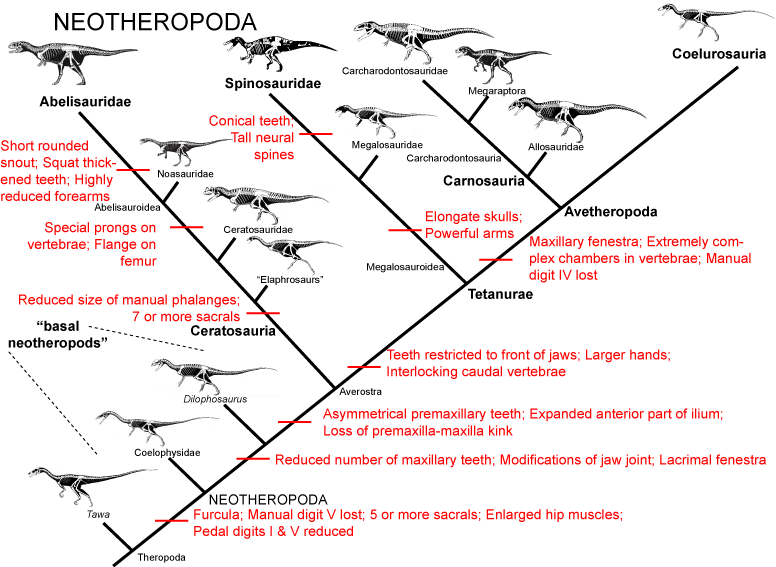
The picture above shows a phylogenetic tree which I am using in my second independent component as a justification for feathers. The dinosaur I am reconstructing is called Allosaurus and it belongs to the grouping called Allosauridae, which is very closely related to a broader group of theropods called Coelursauria where a lot of theropods have been found to have feathers. 

EQ:

How can a paleontologist best reconstruct the life of a prehistoric creature?

Answer #3 (Write in a complete sentence like a thesis statement):

A paleontologist can effectively reconstruct the life of a prehistoric creature by using both phylogenetic context and the comparative method in conjunction with each other or separately.

3 details to support the answer:

- When a creature's phylogenetic context is used by paleontologists, it looks at what other animals, extinct or alive, are closely related to the subject species and what that relationship might reveal about things like appearance, behavior, and diet.

- When a paleontologist uses the comparative method, they are typically looking at the fossilized bones of creatures and comparing them with like creatures and using comparison to postulate with some level of certainty where  muscles were attached or even what color feather-like structures had. 

- Paleontologists that use a creature's phylogenetic context to find closely related species with whom to use the comparative method on can produce very reliable results and provide more information about an ancient creature's life.

The research source(s) to support your details and answer:

- "Evidence for Avian Intrathoracic Air Sacs in a New Predatory Dinosaur from Argentina." This source actually came from the research I was conducting for my Independent Component 2, it reports about how certain features on a species of dinosaur suggest that it may have had the air sacs that birds today use to breath much more efficiently than mammals. The specific group of dinosaurs that this was found on is very closely related to the dinosaur I will be reconstructing, called Allosaurus, which suggests that there is a very real possibility that this anatomical feature was present in the group that contains Allosaurus. This phylogenetic context provides a strong connection between Allosaurus and more bird-like features like primitive feathering.

- "Extreme Dinosaurs" This source talks about a recent discovery of a predator larger than Tyrannosaurus rex, but uses a group of dinosaurs closely related to Tyrannosaurus as a phylogenetic context to justify pack hunting behavior.

- "Flexibility Along the Neck of the Ostrich (Struthio Camelus) and Consequences for the Reconstruction of Dinosaurs with Extreme Neck Length" This source uses the comparative method to compare fossils of long-necked dinosaurs, sauropods, with modern Ostriches, who have very long necks. Through this analysis paleontologists determined positions that would've been more realistically achievable for sauropod neck, thus helping to reconstruct the animal's life.

Concluding Sentence:

Phylogenetic context and the comparative method while being useful on their own for the reconstruction of prehistoric life can be combined to get very reliable and realistic information about the way ancient creatures both behaved and looked like.

Monday, January 4, 2016

Blog 12: Holiday Project Update

My main activity during winter break.


1.    It is important to consistently work on your senior project, whether it is break or we are in school.  What did you do over the break with your senior project?

-      -  I’m going to be honest; I haven’t been very productive over break. The few things I did get done though are a personal tally of how many hours I have spent on my first independent component and also a sort of mental picture of what I want my second independent component to be about.

2.    What was the most important thing you learned from what you did, and why?  What was the source of what you learned?

-      -  As I said before, I thought about what I was going to do for my second independent component (I want to do a complete reconstruction of a dinosaur of my choosing). My main issue is thinking of what materials that I will use that will both be sturdy and cheap. It occurred to me to look up what museums use to connect the bones so I looked it up and found this FAQ (my source) and as it turns out they use steel rods to connect individual bones. From this, I learned that whatever I do I’m going to need strong but malleable wire, which is important because the frame work of my dinosaur needs to be able to bear the weight of what I do on top of it and not bend the frame inward.

3.  Your third interview will be a 10 question interview related to possible answers for your EQ. Who do you plan to talk to and why?


-      -  For my third interview, I’m planning on talking to Gabriel Santos, museum collections manager of the Raymond M Alf Museum, because he is currently studying a type of ocean hippo which means that interviewing him would allow me to probe his studies and to find out what type of analyses push his research along more.

Tuesday, June 2, 2015

Blog 1 – Senior Final Lesson/Interview Reflection


1. What three lessons were most helpful for you to see, and why?

-One lesson that I found very helpful was Myles' lesson  on small animal veterinary medicine, because it showed me that having passion for your topic helps to engage the audience. JJ's lesson was also very helpful because at some points of his lesson I found that his voice became very monotone and it made the presentation more boring when he talked like that. The Astrophysics presentation also taught me that even though you have three separate answers for your EQ, because the Astrophysics lesson had answers to the EQ that built upon each other.


2. List one thing that you learned about the senior project in interviews that will help you get off to a good start?

-One thing that I learned from the interviews was that there would be times during my senior year where I have very few homework, but that this time isn't to be wasted because I can instead use that time to work on my project.

3. What topic(s) are you considering, and why?

-I am thinking about doing Paleontology because I've loved that field of science ever since I was a toddler and because I really want to explore it thoroughly as a career path.

4. What EQ do you think might be interesting to consider in guiding a project like this? (Please don't worry about any sort of formula...we want this question to come from your genuine interest).

-What is the most important thing that a fossil can tell a paleontologist about an extinct species?

5. What are some ideas you have about finding summer mentorship?

-I actually have already contacted the curator of Paleontology (who already knows me) at the museum that I volunteer at and he has accepted, but lately we've been having communication issues and so I plan on calling him.